Why most oil traders lose money.
Broker disclosures consistently show that 70–80% of retail CFD traders lose money. In oil trading specifically, the loss rate may be even higher because oil has unique risks that forex traders aren't prepared for — weekend gaps from geopolitical events, inventory report spikes, and monthly futures rollover. Understanding why traders lose is the first step to making sure you don't become another statistic.
Weekend gap risk
This is the #1 oil-specific account killer that forex traders don't see coming. Oil is uniquely vulnerable to weekend geopolitical developments — Middle East tensions, Russia-Ukraine escalations, Strait of Hormuz incidents. A trader holding a standard lot over the weekend can wake up to a $2-$5 gap (200-500 cents × $10/cent = $2,000-$5,000 loss). A $1,000 account holding 0.50 lots through a Sunday gap can be margin-called before they even see the chart.
EIA inventory report stops getting destroyed
Every Wednesday at 10:30 AM ET, the EIA releases crude inventory data. The initial spike routinely runs 50-150 cents in under a minute. Traders with normal 20-30 cent stops get stopped out instantly — not because their trade direction was wrong, but because their stop was too tight for the event's volatility. Then price often reverses and runs in their originally-intended direction, but they're already out.
OPEC+ meeting surprises
OPEC+ production quota decisions can move oil $3-$8 per barrel. The communiqué can release at any moment during a meeting — there's no fixed schedule. Traders holding full positions into meetings are essentially gambling. The smart play is reducing position size 50% or closing entirely before the meeting, then re-entering after the outcome is known.
Rollover mismanagement
Unlike spot forex, oil futures expire monthly. If your broker automatically rolls your position to the next contract, you'll experience a price adjustment that can look like a random profit or loss. Traders who don't understand their broker's rollover policy can get confused and make bad decisions. Contango (futures above spot) means rollover costs you money every month — this adds up for position traders.
The 1% rule explained.
The 1% rule is the foundation of professional risk management: never risk more than 1% of your account balance on any single trade. This simple rule provides a mathematical safety net that protects you from ruin even during inevitable losing streaks.
Here's why the math matters:
With 1% risk per trade
With 5% risk per trade
The key insight: losses compound asymmetrically. A 10% drawdown requires an 11% gain to recover. A 50% drawdown requires a 100% gain. The 1% rule keeps your drawdowns in the easily recoverable range.
Practical example — USOIL
You have a $5,000 account. The 1% rule means your maximum risk per trade is $50.
Risk per trade: 1% = $50
Stop-loss distance: 50 cents
Dollar per cent: $10/cent per standard lot (1,000 barrels)
Lot size = $50 / (50 cents × $10) = 0.10 lots
If stopped out: you lose exactly $50 (1% of account).
If TP hit at 100 cents: you gain $100 (2% of account).
Notice how the lot size adjusts based on stop-loss distance. A wider stop (100 cents) would require 0.05 lots to maintain $50 risk. Always calculate, never guess — oil's $10/cent per lot makes miscalculations expensive.
Position sizing for USOIL.
Position sizing is the mechanical process of determining exactly how many lots to trade based on your account size, risk tolerance, and the specific trade's stop-loss distance. For oil, the key number to remember is: 1 cent = $10 per standard lot (1,000 barrels).
Example 1: EIA inventory trade with wide stop
Account: $2,000 | Risk: 1% = $20 | Stop-loss: 60 cents (widened for EIA volatility) | $10/cent per lot
Lot size = $20 / (60 × $10) = 0.03 lots (rounded down)
With 60 cents of breathing room, normal EIA spike noise won't stop you out prematurely.
Example 2: Swing trade with trend-following stop
Account: $10,000 | Risk: 1% = $100 | Stop-loss: 150 cents | $10/cent per lot
Lot size = $100 / (150 × $10) = 0.06 lots (rounded down)
Maximum loss if stopped: $90 (slightly under 1% due to rounding). Placed below key structural support.
Example 3: Small account, micro lots
Account: $500 | Risk: 1% = $5 | Stop-loss: 30 cents | $10/cent per lot
Lot size = $5 / (30 × $10) = 0.01 lots (minimum allowed by most brokers)
Actual risk at 0.01 lots: 30 × $10 × 0.01 = $3.00 (0.6% of account). Small accounts face minimum lot constraints — you either accept slightly less risk or use a slightly wider stop to reach 1% exactly.
Critical rule: always round down. If the formula gives 0.037 lots, trade 0.03 — not 0.04. For oil, every extra 0.01 lots at a 50-cent stop adds $5 of unplanned risk. Over hundreds of trades, this precision compounds into meaningful account protection.
Five oil-specific risks you must manage.
Six mistakes that destroy oil accounts.
Holding through Sunday open
"Nothing bad ever happens on weekends." Until it does. A single geopolitical event — Strait of Hormuz closure, Middle East escalation — can gap oil hundreds of cents. If you're holding 0.50 lots through a $3 gap, that's a $1,500 surprise loss. Close or drastically reduce before Friday close.
Tight stops before EIA reports
Using 20-cent stops when the EIA release regularly produces 50-150 cent spikes is a guaranteed way to get stopped out at the worst price. Either widen stops to 2x normal, reduce position size, or close before 10:30 AM ET Wednesday.
Full position into OPEC+ meetings
OPEC+ decisions are binary events — production cut or no cut. Being right on direction but wrong on magnitude can still lose money. The pre-meeting rally often reverses after the decision regardless of outcome. Reduce to 25-50% of normal size.
Ignoring rollover dates
Oil futures expire monthly, unlike spot forex. Your broker's rollover can trigger unexpected stops and create confusing P&L swings. Mark your calendar with rollover dates and understand the contango/backwardation cost before holding through.
Trading during major news without a plan
Crude oil headlines from Reuters/Bloomberg move prices in seconds. If you don't have a stop-loss in place when a pipeline disruption or SPR release hits the wires, you're exposed. Every trade needs a stop-loss before the news, not after.
Forgetting the 5-cent spread cost
Oil's typical 3-5 cent spread on standard accounts means your trade starts $15-$25 in the red per lot (3-5 cents × $10 × 0.10 lots). Scalpers especially must account for this — taking 10 trades/day with 5-cent spreads costs $5/day just in spread. Use ECN accounts for active trading.
Where to place your stop-loss on oil.
A stop-loss should be placed at the price level where your trade thesis is invalidated — not at an arbitrary number of cents from your entry. Oil requires wider stops than most instruments due to its higher volatility. Here's how to determine stop placement:
Psychological level stops
Oil respects round numbers — $60, $65, $70, $75, $80, $85, $90. If you're buying at $72.50 with $72.00 as support, place your stop at $71.70 (30 cents below the round number). This gives room for the level to be tested without stopping you on the wick. Psychological levels act as magnets for price — the market often tests them before reversing.
ATR-based stops for oil
The Average True Range (ATR) on USOIL's H1 chart typically reads 15-30 cents during normal conditions. A common method: set your stop at 2× ATR(14) from your entry. If ATR(14) on H1 is 25 cents, your stop would be 50 cents from entry. During EIA release windows, ATR can spike to 80+ cents — this is when you need to widen or reduce position size.
Event-adjusted stops
This is the oil-specific approach that separates professionals from amateurs. Check the economic calendar before every trade. On EIA Wednesday, multiply your normal stop by 2-2.5x. On OPEC+ meeting days, multiply by 3-4x or close entirely. On a quiet Tuesday afternoon with no news, your normal stop is fine. The stop distance must reflect expected volatility, not just technical levels.
Trailing stops
Once a trade moves into profit, you can trail your stop to protect gains. For oil:
- Breakeven trail: Move stop to entry once trade reaches 1:1 R:R (e.g., 50 cents in profit with a 50-cent stop).
- Partial close + trail: Close 50% at 1:1 and trail the stop on remaining 50% — oil's trends can run for 200+ cents.
- Swing-point trail: Move stop below each new higher low on H1/H4 as oil trends higher. Oil's structure-based trailing works well because trends are sustained by fundamentals.
- ATR trail: Keep stop at 2× ATR behind current price, recalculated each hour.
How OilSniper handles oil risk.
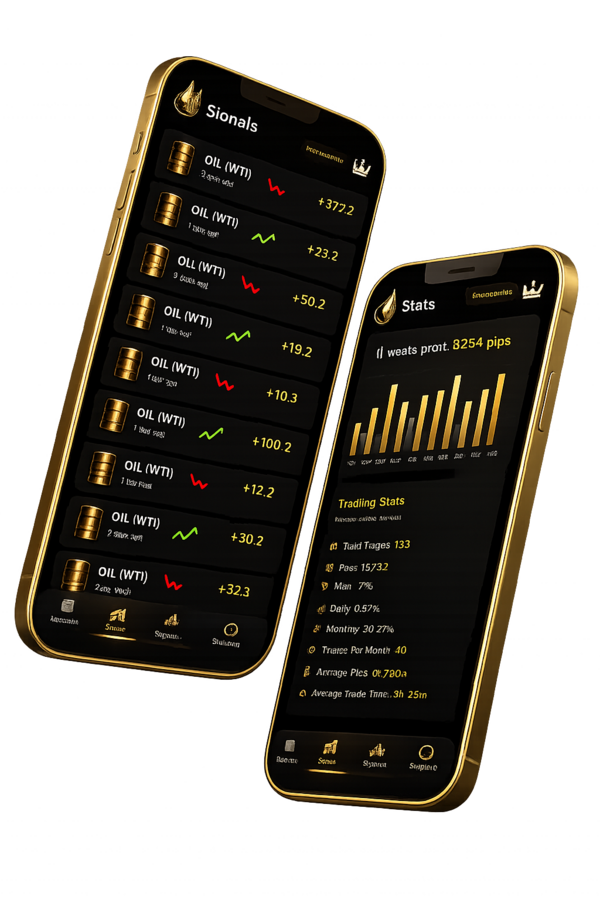
Every OilSniper signal comes with a pre-defined stop-loss and take-profit level. Our analysts account for oil-specific risks — EIA volatility, OPEC+ event windows, weekend gap potential, and rollover dates — before publishing any signal. You never have to guess whether the stop is wide enough for the current volatility environment.
Our signal structure ensures risk management by default:
You still need to calculate your own lot size based on your account balance and the signal's stop-loss distance. Use the USOIL position sizing formula above: Lot Size = (Account × 1%) / (SL cents × $10). Plug in the stop distance we provide, and you'll have the exact lot size that risks 1% of your specific account.
Our 93% accuracy rate means losing signals are rare — a typical OilSniper user sees 1-2 losses per week out of 15-30 signals. When losses occur, they're contained to a small, pre-planned percentage because risk was defined from the start.
Why preventing drawdowns matters most.
The mathematics of recovery are brutally asymmetric. The deeper you draw down, the exponentially harder it is to recover. This table illustrates why capital preservation is the first job of every trader:
| Account Drawdown | Gain Needed to Recover | Difficulty |
|---|---|---|
| 5% | 5.3% | Easy |
| 10% | 11.1% | Manageable |
| 20% | 25.0% | Challenging |
| 30% | 42.9% | Difficult |
| 50% | 100.0% | Very difficult |
| 75% | 300.0% | Near impossible |
| 90% | 900.0% | Account is effectively dead |
This is why the 1% rule exists. With 1% risk per trade, even 20 consecutive losses only results in an 18% drawdown — firmly in "manageable" territory. At 5% risk per trade, just 6 consecutive losses crosses into "very difficult" recovery territory. Oil's unique risks (gaps, EIA spikes, OPEC+ surprises) make the 1% rule even more critical than for other instruments.
Risk management in practice.
See how OilSniper signals include pre-calculated stop-loss and position sizing for USOIL.
Frequently asked questions.
What is the 1% rule in oil trading?
The 1% rule means never risking more than 1% of your account balance on any single trade. For USOIL specifically, calculate lot size as: Lot Size = (Account × 1%) / (Stop cents × $10). A $5,000 account allows $50 risk. With a 50-cent stop, that's 0.10 lots (50 × $10 × 0.10 = $50). This rule ensures that losing streaks — which are statistically inevitable — don't cause catastrophic account damage.
How do I handle EIA inventory report risk?
The EIA report at 10:30 AM ET every Wednesday is oil's biggest weekly volatility event. At minimum: (1) Widen stops to 2x normal width — if your typical stop is 30 cents, use 60+. (2) Reduce position size by 50% if holding through the release. (3) Never use tight stops expecting normal volatility during the EIA window. The initial spike routinely moves 50-150 cents. Better yet, close before the release and re-enter after the trend establishes 30 minutes later.
Should I hold oil positions over the weekend?
Generally no — or at minimum, reduce position size significantly. Oil has the highest weekend gap risk of any major trading instrument due to geopolitical exposure. A Middle East crisis, Russia-Ukraine escalation, or OPEC+ emergency meeting can gap oil $2-$5 (200-500 cents) at Sunday's open. That's $2,000-$5,000 per standard lot. If you must hold, use 25% of your normal position size and ensure your account can absorb a 500-cent adverse gap.
What's a good risk-to-reward ratio for oil?
Minimum 1:2 for most strategies. Oil's 100-300 cent daily ranges make 1:2 and 1:3 ratios consistently achievable. With 1:2 R:R, you only need a 34% win rate to break even. Factor in oil's spread cost (3-5 cents per round turn on standard accounts) — for very tight targets under 20 cents, the spread eats a meaningful percentage of your profit. Ensure your target accounts for the spread. For EIA trades, aim for 1:2.5 or higher given the elevated volatility.
Explore more resources.
What is USOIL?
Complete beginner's guide to oil trading fundamentals.
Read more →Best Brokers for Oil
Compare top brokers — spreads, leverage, and regulation.
Read more →Trading Strategies
EIA inventory trade, OPEC+, seasonal, and correlation strategies.
Read more →Oil Trading Glossary
WTI, Brent, EIA, contango, crack spread — every term defined.
Read more →Trading Tools
USOIL position size calculator, pip calculator, and more.
Read more →Oil Signals
Professional signals with pre-built risk management.
Read more →Trade oil with defined risk.
Every OilSniper signal includes pre-set stop-loss and take-profit levels. Free to download.